16th Street Education and Visitor Center Opens in Birmingham
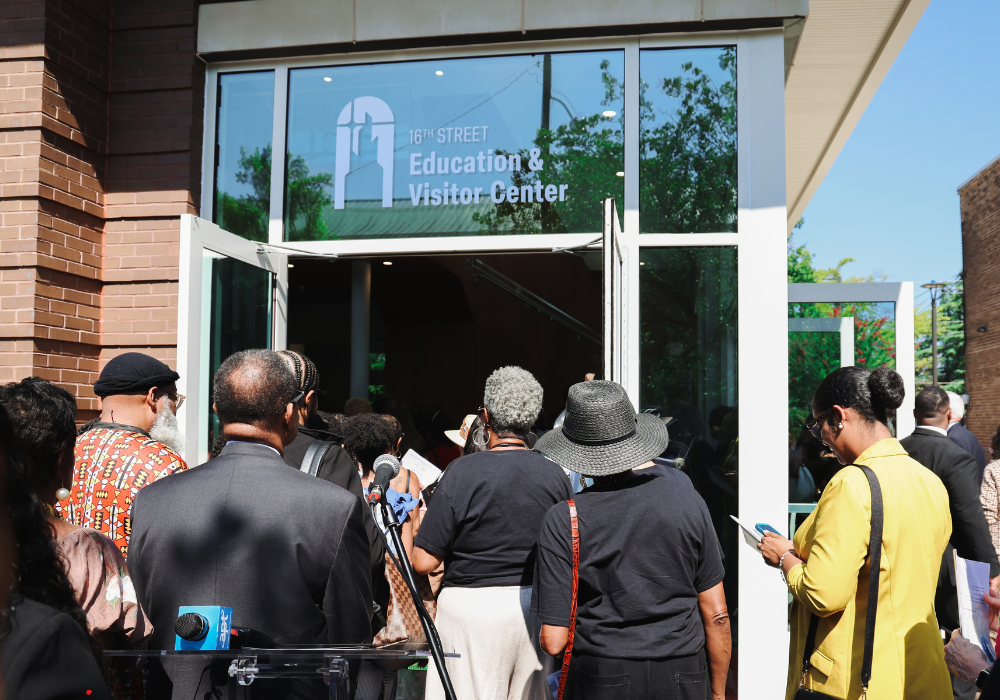
The 16th Street Education and Visitor Center opened on Tuesday, Sept. 15, 2026, on the 63rd anniversary of the 16th Street Baptist Church bombing that claimed the lives of four young girls.
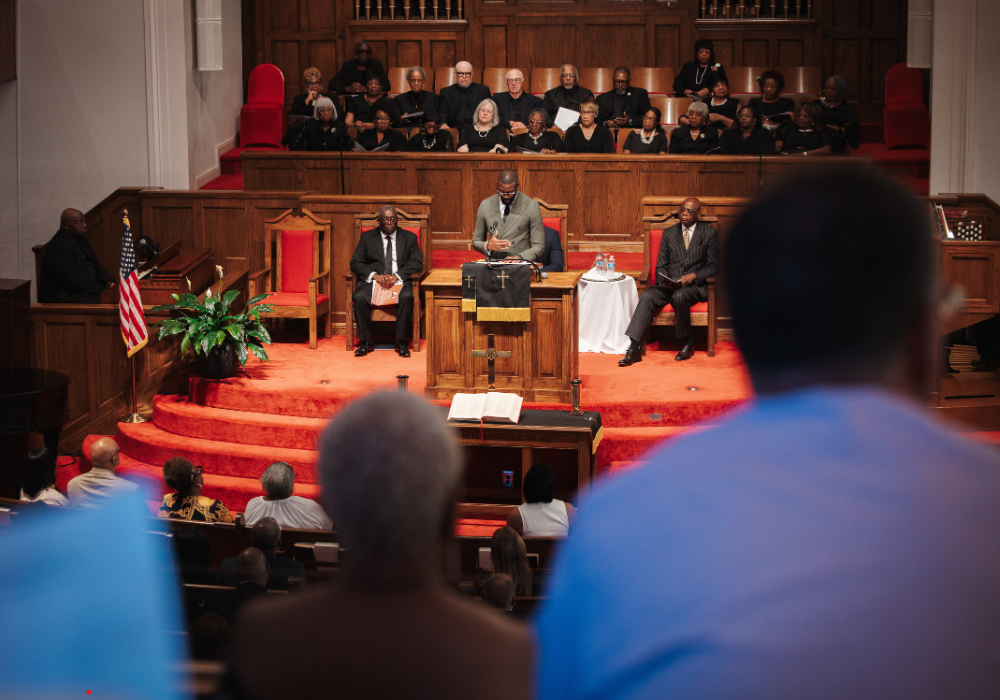
A full program took place in the historic 16th Street Baptist Church. I walked in just as the Carlton Reese Memorial Unity Choir stood to sing “I Love to Praise Him.”
It set the tone for a moving anniversary commemoration and the opening of the center. It was fitting for a new chapter for one of Birmingham’s most significant landmarks.
Birmingham Mayor Randall Woodfin and attorney Bryan Stevenson, founder of the Equal Justice Initiative, joined the community service. By the end of the morning, I’d also heard from the center’s executive director, Dr. Terrence Brown.
A New Education Center Built for Community First
I sat down with Brown and asked him the obvious question — people already know this church’s story, so why should they visit the center?
His answer started with food. Inside the new visitors center sits a restaurant called Koinonia, Greek for community. “Everything that binds us,” Brown told me. Modeled on a communal-table concept, it seats groups of strangers together for a shared meal. “You get to know somebody you may not, under normal circumstances, get to know,” Brown said. “That’s powerful.”
From there, the center opens into spaces built around reflection and making: quilting circles, choral singing, visual art, and a room where visitors are invited to write a haiku about whatever the tour left them feeling.
Former Director of Arts Education for Jefferson County Schools, Brown believes deeply in the power of art to break down walls between strangers. He offered this striking example. “We had 70 people in that room singing, ‘Let there be peace,'” he said, describing a recent gathering at the center.
He pointed to the neurological research showing that a shared song can regulate a room full of strangers’ heartbeats to the same rhythm — proof, in his view, of why the center treats art as more than decoration.
The last stop on the tour is the river wall, a space Brown described as somewhere to reflect and then recommit before stepping back into the world. Public restrooms and community gathering space round out the building, designed with the practical needs of a working historic site in mind.
The center’s quilting program, Quilt of Many Hands, brings people together to create quilts for children in foster care. “A child who is moving in and out of houses will have something beautiful that is theirs,” Brown said. “Something that’s home.”
Brown was candid, too, about who’s actually walking through the doors. Of the roughly 20,000 annual visitors who toured the church in 2025, he said, fewer than 10 percent were locals. Closing that gap through community engagement — book studies, genealogy workshops, sessions on preserving elders’ stories — is now a deliberate second phase of programming.
One Enduring Call for Change
Mayor Randall Woodfin’s remarks kept circling back to the names of the young girls killed in the bombing — Addie Mae Collins, Denise McNair, Carole Robertson and Cynthia Wesley — and to the insistence that saying them, 63 years later, is itself an act of memory that matters.
They were children, he reminded the sanctuary, with families who loved them and dreams they never got the chance to live out.
Woodfin’s charge was less about looking backward than about what the city owes forward: to hold onto the boldness and belief of a child as a civic obligation, not just a historical one. “Even in the face of injustice,” he said, “Birmingham dared to believe change was possible.”
That, Woodfin said, is what helped move the country forward. He closed by urging the room to leave with the optimism of a child, the courage of the four girls, and the faith that tomorrow can be better than today.
A Grandmother’s Hug, a Jar of Soil and a Baton
The morning’s keynote address was delivered by Bryan Stevenson, the civil rights attorney and founder of the Equal Justice Initiative, known nationally for his work on wrongful convictions and for building Montgomery’s National Memorial for Peace and Justice.
Stevenson opened with a story about his grandmother, a domestic worker and the daughter of formerly enslaved people, who helped raise him after Brown v. Board integrated his schools.
He described how she used to hug him so tightly he thought she was trying to hurt him, then ask him, hours later, “Do you still feel me hugging you?” If he said no, she’d hug him again. Decades later, at her deathbed, unable to find the words to say goodbye, it was she who found the words for him: I’m always going to be with you.
Stevenson didn’t stop at the sentimental. He was unflinching about his own reckoning with what it means to be American, describing a night in law school when police surrounded his car with guns drawn simply because he didn’t “belong” in his own neighborhood, and the decades since spent watching the presumption of innocence disappear for his clients because of the color of their skin.
He admitted, plainly, that experiences like these had made him question his identity as an American more than once. But he told the congregation he’d made a decision: to be “a great American” anyway, one who understands that greatness sometimes means standing up when others say sit down, and speaking when others say be quiet.
That decision is what made the story he told next land the way it did.
Stevenson described a woman who traveled to rural West Alabama to collect soil from a lynching site for the Equal Justice Initiative’s Community Remembrance Project. She was kneeling on a dirt road when a white man in a pickup truck stopped, turned around and walked toward her. He stopped and asked what she was doing, and then asked if he could help.
As they filled the jar together, he told her he feared his own grandfather had been involved in lynchings on that same road. Before they parted, he asked if he could take a photo with her, holding the jar of soil between them.
He closed with the image of a relay — a baton passed from those who survived slavery, to those who survived lynching, to those who stood in this sanctuary 63 years ago, and now into the hands of everyone in the pews. The question, he said, is whether they will take the baton and run.
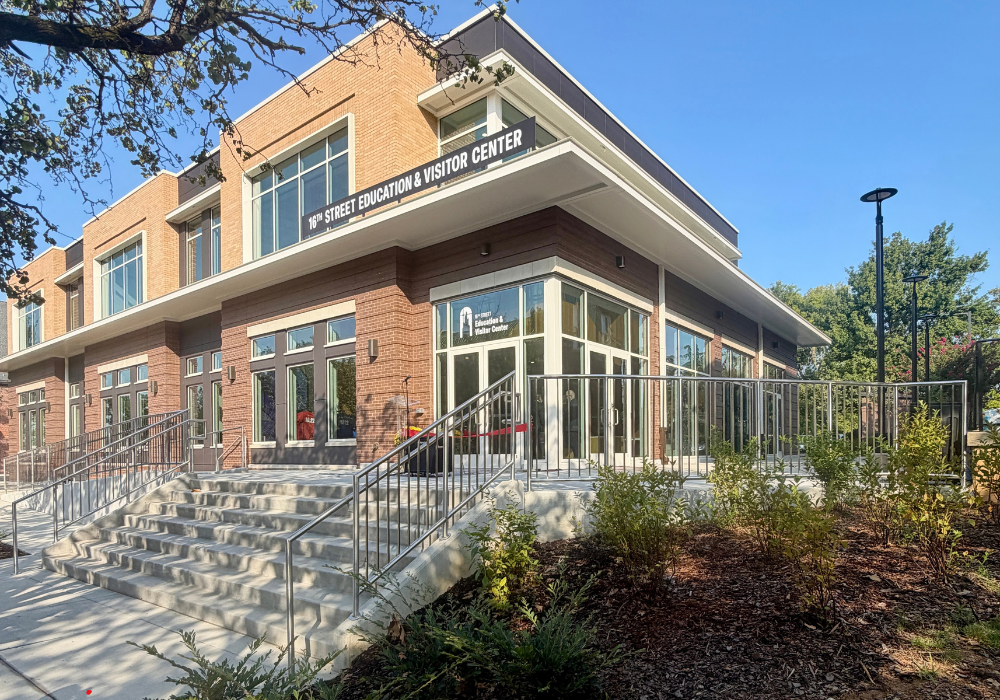
Know Before You Visit the 16th Street Education and Visitor Center
Planning a visit to the 16th Street Education and Visitor Center? Here are the essential details to know before you go.
Where is the center located?
The center is located at 1512 Sixth Avenue North in downtown Birmingham, beside the historic 16th Street Baptist Church and across from Kelly Ingram Park.
What are the hours?
Tours and the gift shop are open Tuesday through Saturday from 10 a.m. to 4 p.m. The center is closed on Sundays and Mondays. The final admission is one hour before the galleries close, so visitors should arrive by 3 p.m.
How much does admission cost?
Admission is $10 for adults and $5 for visitors ages 18 and younger. Tickets may be purchased online or in person. Groups of 40 or more should contact the tour office in advance.
How long does a visit take?
The tour typically takes approximately 90 minutes. Allow enough time to experience the galleries and pause in the center’s spaces for reflection.
Where can visitors park?
Free parking is available behind the building, with access from 15th Street North.
Is the center accessible?
The center is fully accessible. Designated parking spaces and a ground-level entrance are located near the parking lot. Ramps and elevators provide access to the entrance and lobby, and a limited number of wheelchairs are available at the security station.
Can visitors take photographs?
Noncommercial photography and video are permitted unless otherwise noted. Flash photography, tripods, monopods and selfie sticks are prohibited inside.
Can you eat at the center?
Yes. Koinonia serves Southern food in a space created to encourage fellowship and conversation. Visitors may choose communal dining, fast dining or takeout, and catering is also available. The restaurant is open Tuesday through Sunday from 10:30 a.m. to 3 p.m. Because its menu is still forthcoming, check the official Koinonia page for updates before visiting.
The center is within walking distance of Kelly Ingram Park and the Birmingham Civil Rights Institute, making it easy to experience several important sites in Birmingham’s Civil Rights District during the same outing.
Visit the official 16th Street Education and Visitor Center website for current hours, admission information and event updates.